
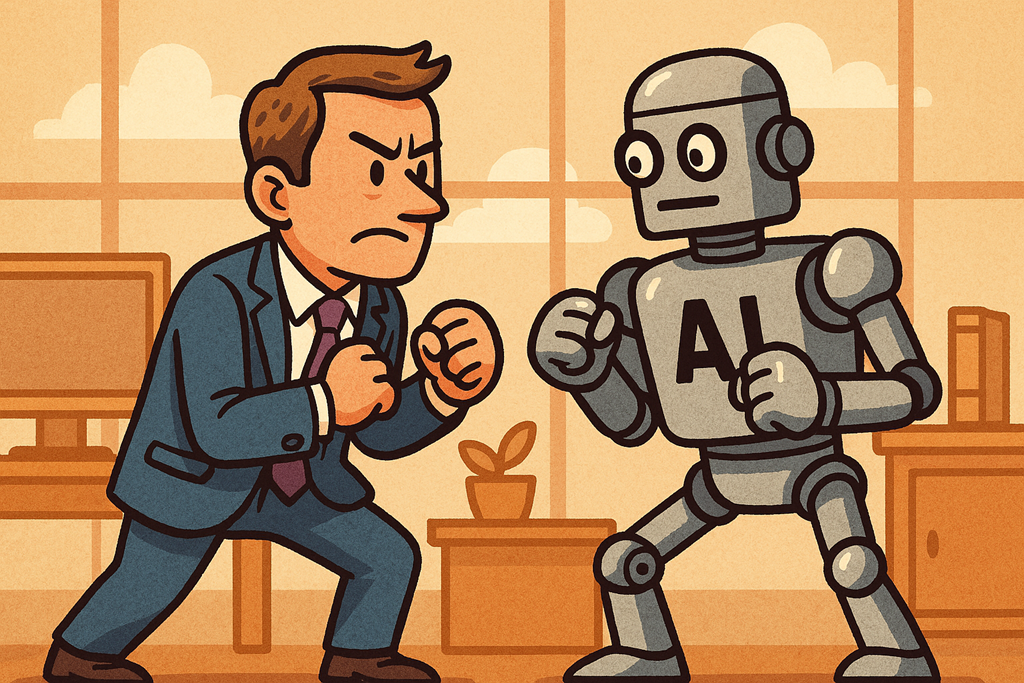
If you’ve been paying attention to the headlines, you’d be forgiven for thinking AI is about to wipe out half the knowledge economy. Faster answers. Instant content. Automation everywhere.
And yet, when you look closely, something else is happening.
AI isn’t eliminating value.
It’s making shallow value painfully obvious.
For MSPs, this matters more than most people realise.
Because the MSP model has always sat at the intersection of technology and judgement. Tools have never been the differentiator. Thinking has.
There are six very human capabilities that still outperform machines. Not technical skills. Not certifications. But ways of thinking and behaving. And when you translate those into an MSP context, they become a pretty blunt warning:
If your business is built on “doing tasks”, AI will hollow it out.
If it’s built on judgement, taste, and responsibility, AI will amplify it.
Let’s break that down.
1. Questioning beats knowing
AI is incredible at answers. That’s the point.
But MSPs don’t win by having answers. They win by asking better questions than their clients know to ask.
“What’s the cheapest backup?” is an answer problem.
“What are we actually trying to protect, and why?” is a question problem.
The uncomfortable truth is that many MSPs trained themselves to be answer vending machines. Ticket in, solution out. AI will do that faster, cheaper, and without burnout.
The MSPs who survive are the ones who can slow the conversation down, challenge assumptions, and reframe the problem entirely. That’s not automation-resistant. That’s automation-proof.
2. Taste is becoming a commercial advantage
AI can generate endless options: architectures, policies, scripts, proposals, documentation.
What it can’t do is decide what’s good.
Good enough for this client.
Appropriate for this risk profile.
Aligned with this business reality.
That’s taste. And in a world drowning in AI‑generated mediocrity, taste becomes a filter clients are willing to pay for.
MSPs who develop strong opinions, clear standards, and consistent design thinking will stand out. The ones who proudly say “we don’t do it that way” will win more trust than those who say “yes” to everything.
3. Iteration beats perfection
AI encourages speed. MSPs have historically rewarded caution.
The best operators are learning to combine both.
They ship at 80%.
They test with real clients.
They refine relentlessly.
Whether it’s service offerings, internal processes, or security baselines, iteration matters more than ever. AI accelerates drafts. Humans improve outcomes.
MSPs who wait until something is perfect will be outpaced by those willing to learn in public.
4. Composition is where strategy lives
AI is excellent at producing parts.
Humans are better at assembling wholes.
MSPs don’t add value by listing tools. They add value by composing solutions that make sense together: security, compliance, user experience, business constraints, and human behaviour.
Anyone can deploy products. Few can design systems that actually work in the messiness of real organisations.
That synthesis – pulling threads together into something coherent – is not a technical skill. It’s a strategic one.
5. Allocation is the new leverage
The old hero MSP was the one who could do everything themselves.
The modern MSP wins by knowing what should be done by AI, what should be done by people, and what should never be automated at all.
That’s allocation.
Time, attention, tools, staff, AI systems – all aimed deliberately. Not reactively.
MSPs who treat AI as “just another tool” will underuse it. MSPs who treat it as an intelligence multiplier will restructure their businesses around it.
6. Integrity is the real differentiator
AI has no conscience.
No accountability.
No stake in the outcome.
That burden falls squarely on the MSP.
Privacy decisions. Security trade‑offs. Risk acceptance. Truthful advice when the easy path is more profitable.
As AI amplifies impact, integrity stops being a soft value and becomes a leadership skill.
Clients don’t just need faster answers. They need someone willing to say “no”, push back, and protect them from bad decisions – even when AI confidently suggests otherwise.
The bottom line
AI isn’t coming for MSPs.
It’s coming for undifferentiated thinking.
The future belongs to MSPs who lean harder into what makes them human: judgement, taste, curiosity, responsibility, and the courage to think rather than just respond.
When the world gets more artificial, the smartest move an MSP can make is to get more human.
And that’s not a threat.
That’s an opportunity.
 CIAOPS