
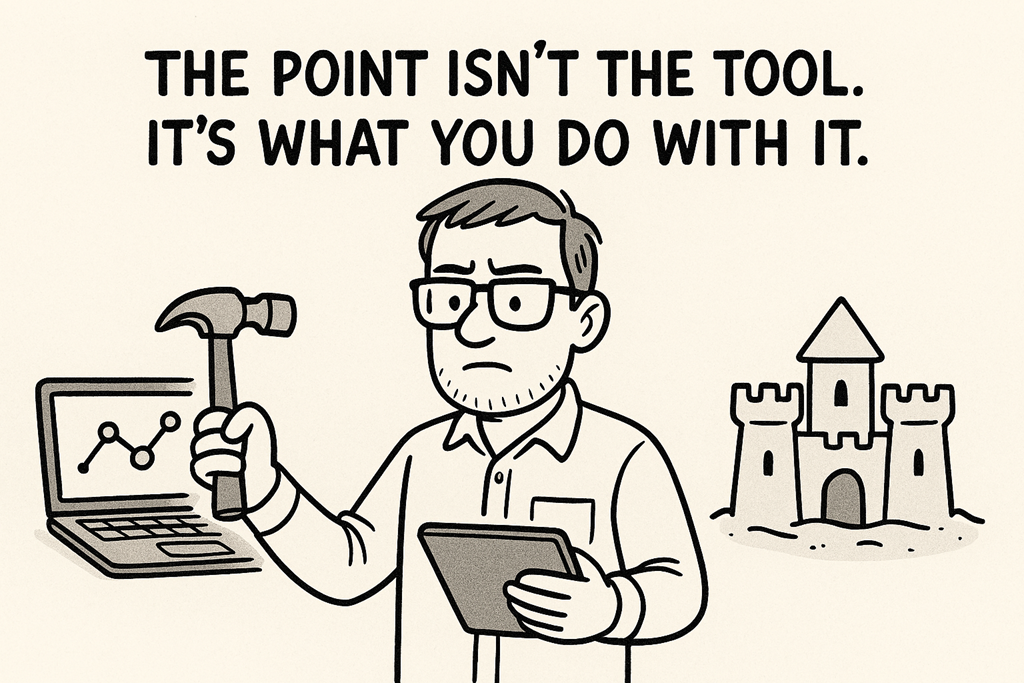
There’s a short video doing the rounds at the moment that a lot of people are nodding along to.
Not because it’s packed with new information.
Not because it introduces some breakthrough idea.
But because it quietly exposes something most MSPs would rather not look at too closely.
We’re very good at having things.
We’re not nearly as good at using them properly.
And no, this isn’t another “AI will change everything” post. It’s about something more uncomfortable than that.
It’s about intent.
Most MSPs Don’t Have a Capability Problem
Talk to almost any MSP today and you’ll hear a familiar list:
- Microsoft 365
- Copilot (or at least a licence or two)
- Security tooling
- Automation platforms
- Documentation systems
- PSA, RMM, scripts, templates, frameworks
On paper, the stack looks impressive.
In reality?
Most of it is sitting there like gym equipment in January.
Owned.
Rarely used properly.
Almost never used deliberately.
The video’s real value isn’t what it shows — it’s what it implies: tools don’t create leverage. Decisions do.
Using Something Isn’t the Same as Leveraging It
Here’s the trap MSPs fall into:
“We’ve deployed it, so we’re using it.”
No, you’re not.
You’re exposed to it.
Leverage only happens when a tool meaningfully changes one of three things:
- Speed – you move faster with less friction
- Quality – the output is materially better
- Capacity – you can do more without more people
If none of those shift, the tool is just decoration.
Copilot that drafts emails you’d write anyway?
Nice. Not leverage.
Automation that still needs babysitting?
Helpful. Not leverage.
Security tooling that generates alerts nobody reads?
Expensive. Definitely not leverage.
The Real Gap Isn’t Technical. It’s Cognitive.
What the video quietly highlights is this:
Most people don’t struggle with access to capability. They struggle with changing how they think.
MSPs love new products because products don’t demand introspection.
But leverage does.
Leverage forces uncomfortable questions:
- What should we stop doing because the machine can now do it better?
- What human work actually matters here?
- What outcome are we optimising for — speed, margin, quality, or control?
- Are we designing workflows, or just reacting to features?
That’s the part most MSPs skip.
Why This Matters for MSP Business Models
Here’s the uncomfortable truth.
If two MSPs have access to the same tools, the one that wins isn’t the one with the better stack.
It’s the one with the clearer intent.
One MSP uses Copilot to “help staff write faster”. Another redesigns service delivery so first‑pass responses, documentation, and reporting are largely machine‑assisted — and humans step in where judgement matters.
Same licence.
Very different business.
One MSP adds another security platform. Another uses the platforms they already own to reduce noise, tighten scope, and clearly articulate risk to the client.
Same technology.
Different outcomes.
This Is Why So Many MSPs Feel Stuck
They’re busy. They’re licensed. They’re “doing AI”.
And yet… nothing really changes.
Margins don’t improve. Staff are still stretched. Clients don’t magically become easier.
Because activity has replaced design.
The video doesn’t give you a roadmap — and that’s the point. It’s not about copying what someone else is doing. It’s about recognising that leverage is intentional, not accidental.
The Question MSPs Should Be Asking
Not:
“What tool should we add next?”
But:
“What outcome do we want this tool to fundamentally change?”
If you can’t answer that clearly, the tool won’t save you. It’ll just make you busier.
The gap between MSPs who thrive and MSPs who stall is getting wider. Not because of access to technology — but because of how deliberately they use it.
The video is just a mirror.
What you see in it depends entirely on how honestly you’re willing to look.
 CIAOPS