
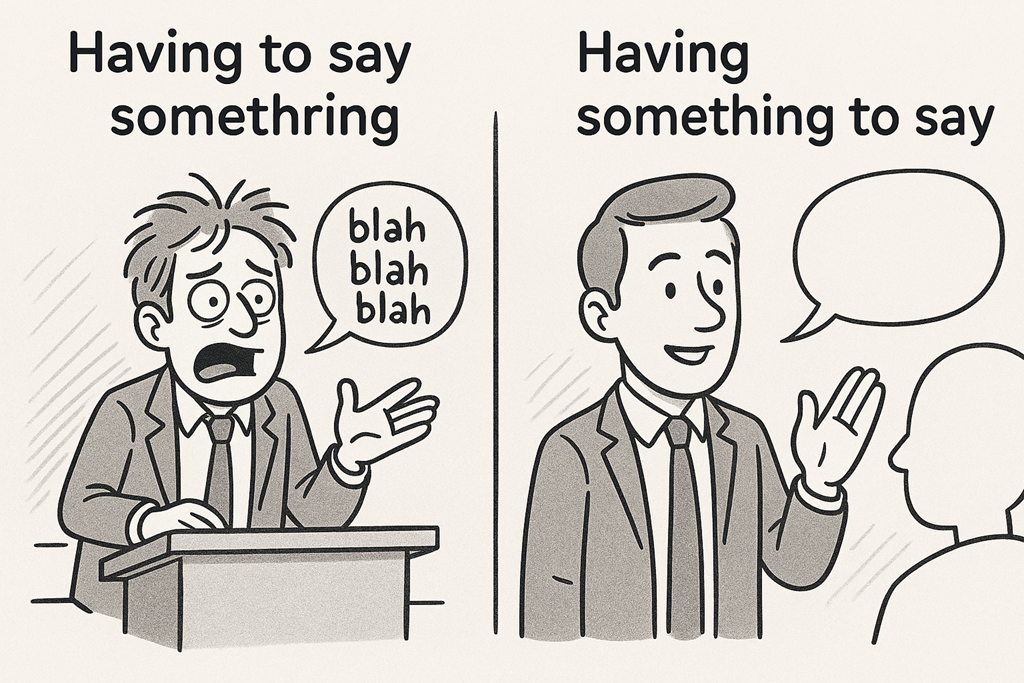
There’s a big difference between having to say something and having something to say.
Most MSPs don’t struggle with the first one.
They struggle with the second.
Every week, there’s another reason you “should” be communicating.
Another vendor update.
Another security alert.
Another AI announcement.
Another reminder that you haven’t emailed your clients in a while.
So you send something.
Anything.
And that’s the problem.
Because when you’re just having to say something, your message sounds like every other MSP message sitting unread in your client’s inbox. It’s safe. It’s generic. It’s instantly forgettable. Your own material warns against this exact trap—joining the “barrage of sameness” that clients have learned to ignore.
Noise Isn’t Leadership
Let’s be blunt: clients don’t need more noise.
They don’t need another checklist that looks like it came from a vendor marketing kit. They don’t need another “we’re here for you” email that doesn’t actually change anything for them. They don’t need another LinkedIn post that could have been written by any MSP, anywhere, at any time.
That’s not communication. That’s obligation.
And obligation-driven communication always feels hollow, because it is.
When you have to say something, the goal is compliance.
When you have something to say, the goal is leadership.
Those two mindsets produce very different outcomes.
Saying Something vs Saying It Because It Matters
When an MSP actually has something to say, it usually comes from experience:
- A pattern they’re seeing across multiple clients
- A mistake they’ve watched businesses repeat
- A hard lesson learned the expensive way
- A clear opinion formed by doing the work, not reading the brochure
That’s why your own guidance consistently leans toward education over promotion—teaching the market rather than pitching at it.
Clients pay attention to that. Not because it’s polished, but because it’s real.
It sounds different.
It feels earned.
And most importantly, it helps them make sense of a messy, confusing technology landscape without pretending everything is simple or risk-free.
Why Most MSP Content Fails
Here’s the uncomfortable truth: most MSP messaging fails because it’s designed to avoid discomfort.
It avoids strong opinions.
It avoids taking a stance.
It avoids the risk of being wrong.
So it defaults to:
- “Here’s what Microsoft announced”
- “Here’s why AI is important”
- “Here’s a list of best practices”
None of those are wrong. They’re just empty without context.
Clients aren’t looking for information. They can get that anywhere.
They’re looking for interpretation.
What does this actually mean for them?
What should they worry about?
What can safely be ignored?
What’s hype, and what’s real?
That’s where having something to say matters.
Thought Leadership Isn’t Louder. It’s Clearer.
Real thought leadership isn’t about posting more often. It’s about posting with intent.
It’s saying:
“Here’s what we’re seeing, and here’s what we think businesses should do about it.”
That’s why the strongest MSPs don’t communicate constantly—but when they do, people read it. Because the message earns attention rather than demanding it.
You see this clearly in your own training and enablement work: adoption happens when people understand why something matters, not just what changed.
The same rule applies to marketing and client communication.
If You Don’t Have Something to Say, Don’t Say Anything
This might sound counterintuitive, but it’s one of the most powerful shifts an MSP can make:
If you don’t have something meaningful to add, stay quiet.
Silence is better than filler.
Because filler teaches your audience to ignore you.
But when you wait until you genuinely have something to say—something shaped by experience, pattern recognition, and a point of view—your message lands differently. It carries weight. It builds trust. It positions you as a guide, not a broadcaster.
The Real Question for MSPs
Before you send the next email, write the next blog post, or schedule the next LinkedIn update, ask yourself one question:
Am I saying this because I feel like I should…
or because it actually helps someone understand their world better?
If it’s the first, pause.
If it’s the second, lean in.
Because MSPs who always have something to say are easy to ignore.
MSPs who only speak when it matters?
They’re the ones clients listen to.
 CIAOPS