
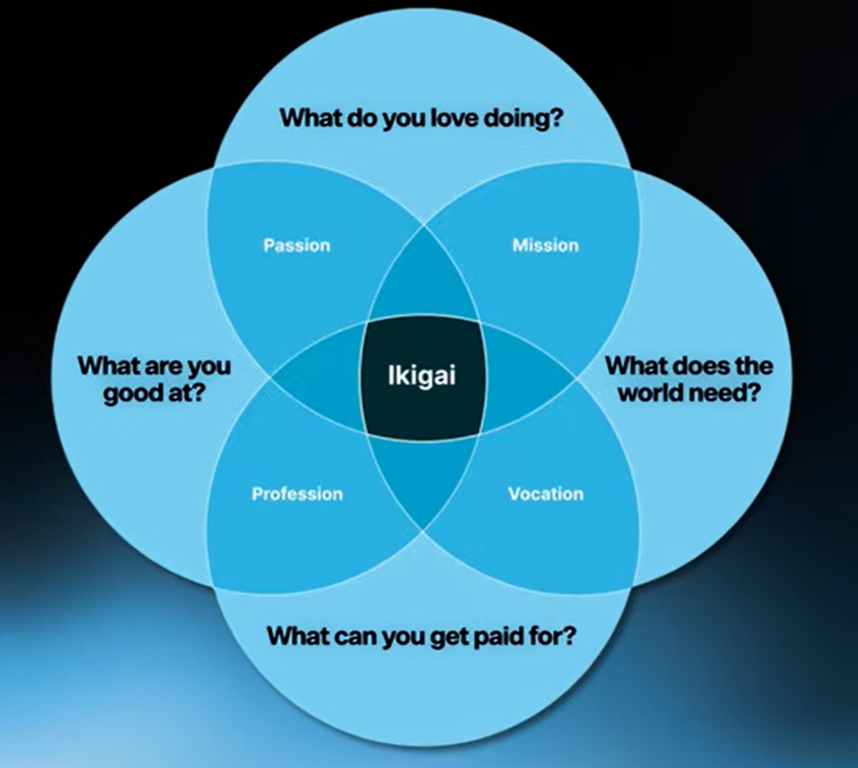
This image looks simple. Four overlapping circles. A neat little centre labelled Ikigai.
But if you’re an MSP, it’s also deeply uncomfortable.
Because it forces you to confront a truth most MSPs spend years avoiding: being busy is not the same as being aligned, and technical competence alone is not a business strategy.
The four questions in the diagram are brutal in their honesty:
- What do you love doing?
- What are you good at?
- What does the world need?
- What can you get paid for?
Most MSPs answer one of these well. Some manage two. Very few ever land in the centre.
And that’s why so many MSP businesses feel hard, fragile, and exhausting.
The comfort trap: what you’re good at
Let’s start with the most common circle MSPs live in: What you’re good at.
You’re good at fixing problems. You’re good at understanding Microsoft licensing. You’re good at cleaning up messes other providers left behind. You’re good at solving technical puzzles under pressure.
That competence is usually what got you into business in the first place.
But being good at something doesn’t automatically make it valuable in the market. And it definitely doesn’t mean customers will pay a premium for it.
Most MSPs build their entire offering around their internal strengths instead of external demand. They sell what they know, not what clients actually buy.
That’s how you end up competing on price, hours, and response times—because those are the only visible differentiators left.
Passion alone doesn’t pay the bills
Then there’s the what you love doing circle.
This is where a lot of MSPs retreat when things get hard. “I just want to do the technical work.” “I hate sales.” “I didn’t start this business to market myself.”
The problem is that passion without commercial alignment turns into resentment.
You can love building security architectures or automating tenants all day long—but if customers don’t understand, value, or budget for that work, your passion quickly becomes unpaid labour.
Worse, you start blaming clients for “not getting it” instead of recognising that it’s your job to connect value to outcomes.
The ignored circle: what the world actually needs
This is the most neglected part of the diagram for MSPs.
What does the world need right now?
Not more backup tools.
Not another RMM platform.
Not a 50‑page security report no one reads.
What the world needs is clarity, risk reduction, proof, and outcomes.
Small businesses don’t wake up wanting Microsoft 365 Business Premium configured “correctly”. They want fewer incidents, less anxiety, and confidence they won’t be the next headline.
MSPs that align with actual business pain stop selling technology and start selling relief.
That’s when conversations change. That’s when objections drop. That’s when trust accelerates.
The harsh reality: what you can get paid for
This is where ego goes to die.
You might believe your service is worth more. You might know you deliver more value. But the market doesn’t pay for effort—it pays for perceived outcomes.
If customers won’t pay for something, it doesn’t matter how elegant, secure, or technically correct it is.
This is why so many MSPs stay stuck at the same revenue level for years. They keep adding services without increasing commercial clarity.
The result? Bigger stacks, thinner margins, and more stress.
Ikigai is alignment, not balance
The centre of the diagram—Ikigai—isn’t about doing everything equally. It’s about alignment.
When what you love doing overlaps with what you’re good at, what the market actually needs, and what customers will happily pay for, work stops feeling like friction.
Sales becomes easier.
Marketing becomes clearer.
Decisions become simpler.
You stop chasing every opportunity and start choosing the right ones.
What this means for your MSP
If your business feels hard, it’s probably not a motivation problem or a talent problem.
It’s an alignment problem.
Ask yourself:
- Which services do clients repeatedly say yes to without negotiation?
- Which conversations energise you instead of draining you?
- Which outcomes do customers thank you for—not just tolerate?
- Which offers would still make sense if tools and vendors disappeared tomorrow?
Your answers won’t come from another product, platform, or certification.
They come from stepping back and being honest about where your business actually sits in this diagram.
Because the goal isn’t to do more.
The goal is to finally operate from the centre.
 CIAOPS