
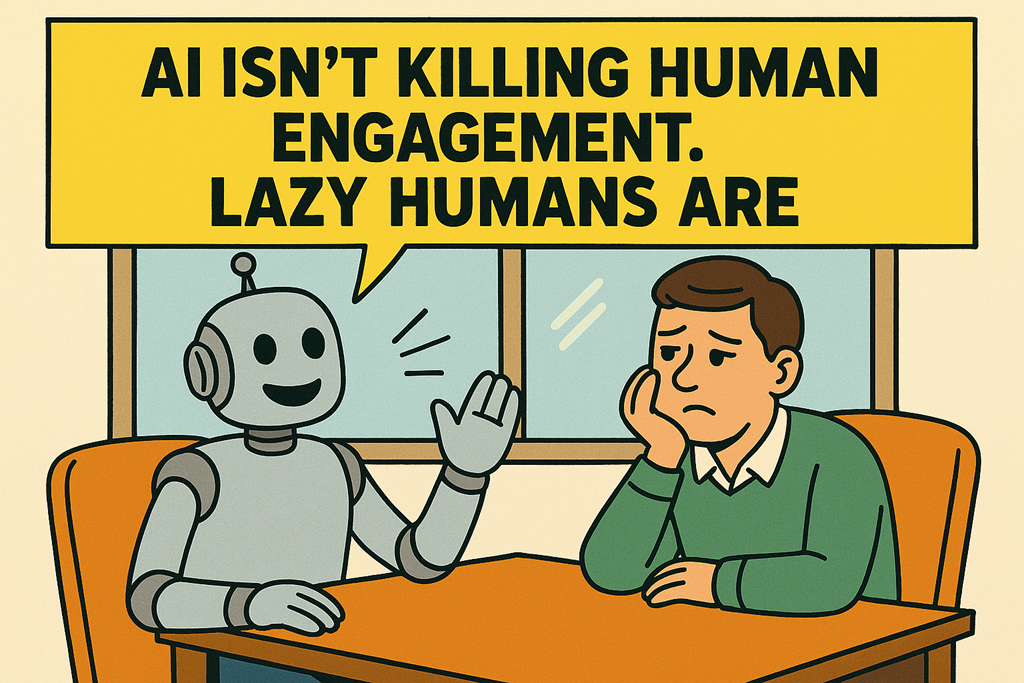
There’s a growing narrative doing the rounds that AI is stripping the humanity out of business. That by automating answers, accelerating responses, and generating content at scale, we’re somehow eroding trust, relationships, and the very engagement that drives growth.
It sounds compelling. It’s also mostly wrong.
The real problem isn’t artificial intelligence. The problem is how people are choosing to use it.
Yes, AI is changing how work gets done. No argument there. But the idea that AI is inherently killing human engagement misunderstands both technology and people. Tools don’t destroy relationships. Behaviour does.
AI Doesn’t Remove the Human Layer — It Exposes It
When someone pastes a generic AI-generated answer into a forum and pretends it’s expertise, the issue isn’t that AI exists. The issue is that the person posting it had nothing to contribute in the first place.
Before AI, those same people were still present. They were just slower. They copied blog posts, paraphrased documentation, or regurgitated vendor marketing. AI hasn’t created impostors. It’s simply made them more obvious.
In fact, the faster and more polished low-effort content becomes, the more valuable genuine human contribution actually is.
When everyone can generate an answer in seconds, context, judgement, and experience become the differentiators. AI raises the bar. It doesn’t lower it.
People Don’t Buy From Paragraphs — But They Never Did
“People buy from people” gets repeated a lot, usually as a defence against change. But let’s be honest: people don’t buy from people because they typed every word themselves.
They buy from people who:
- Understand their situation
- Ask better questions
- Explain trade-offs clearly
- Stand behind their advice
- Show up when things go wrong
None of that disappears because AI exists.
If your relationship with a client is so fragile that it collapses the moment you use Copilot to draft an email or summarise a proposal, then the relationship was transactional to begin with.
AI doesn’t replace trust. It reveals whether there was any there.
AI Used Properly Creates More Human Engagement, Not Less
Here’s the part critics consistently miss: AI removes friction. And friction is what stops people engaging properly in the first place.
Think about where MSPs actually struggle:
- Keeping up with documentation
- Responding quickly and clearly
- Translating technical detail into business language
- Being consistent across staff
- Following up properly
AI helps with all of that.
When used well, AI:
- Frees time for real conversations
- Improves clarity and consistency
- Reduces cognitive load
- Helps junior staff communicate better
- Allows senior staff to focus on judgement, not typing
That doesn’t reduce engagement. It improves it.
Clients don’t want to watch you struggle through a Word document to prove you’re “human”. They want outcomes, understanding, and confidence that you know what you’re doing.
The Relationship Layer Isn’t Being Killed — It’s Being Filtered
What is happening is that noise is being stripped away.
Communities, forums, and social platforms are getting flooded with low-effort content because the cost of producing it has dropped to near zero. That’s uncomfortable, especially for people who built reputations on being the fastest responder or the loudest voice.
But signal always reasserts itself.
People quickly learn who adds value and who doesn’t. They remember who explains why, not just what. They gravitate to those who share lived experience rather than polished output.
AI accelerates that sorting process.
If anything, it makes authenticity more important, not less.
MSPs Don’t Win by Rejecting Tools — They Win by Using Them Better
MSPs have always differentiated themselves by how they apply technology, not whether they avoid it.
We didn’t refuse automation because scripts looked impersonal.
We didn’t reject cloud because servers felt more “hands on”.
We didn’t avoid remote management because onsite felt more “real”.
AI is no different.
The MSPs who will win are the ones who:
- Use AI to enhance communication, not replace thinking
- Apply it with accountability and transparency
- Combine AI speed with human judgement
- Train staff to use it responsibly
- Keep ownership of advice and outcomes
Those who don’t will still exist. They’ll just be slower, noisier, and increasingly irrelevant.
The Real Risk Isn’t AI — It’s Abdicating Responsibility
If someone uses AI to speak on topics they don’t understand, that’s not a technology failure. That’s a professional one.
AI doesn’t force anyone to cosplay as an expert. It just removes the excuse of effort.
At the end of the day, trust still comes from ownership. From standing behind what you say. From being accountable when things don’t go to plan.
AI can help you communicate. It can help you think. It can help you scale.
What it can’t do is care.
And that’s exactly why the human layer isn’t disappearing any time soon.
It’s just being reserved for those who actually deserve it.
 CIAOPS