
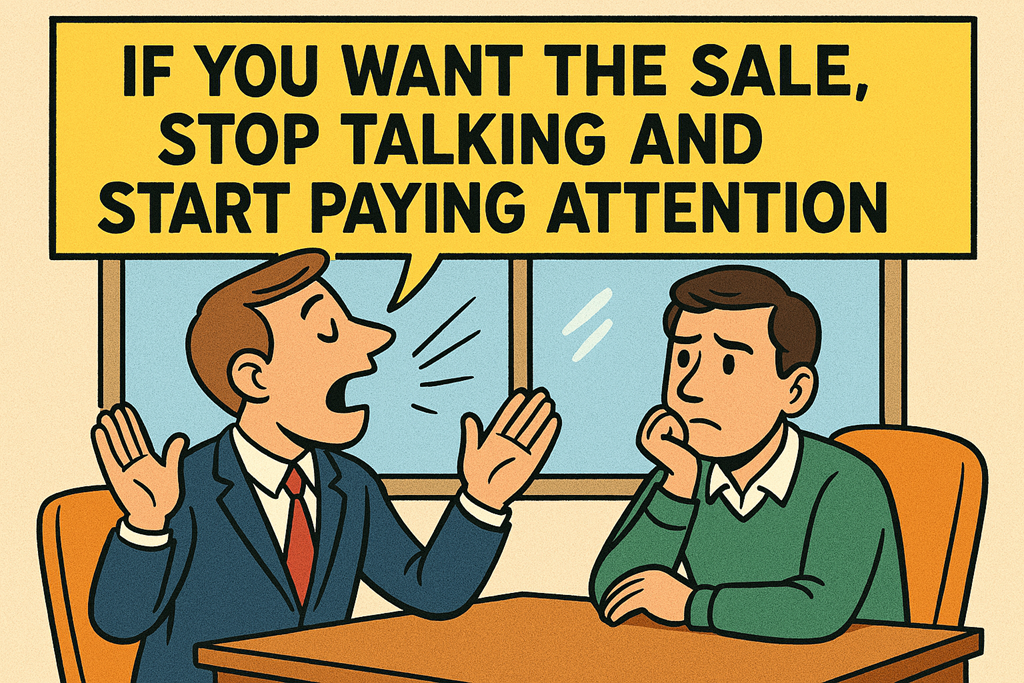
There’s a simple truth most MSPs don’t like hearing:
People don’t buy what you want to sell.
They buy what they want to achieve.
And yet, every day, MSPs jump on calls armed with decks, bundles, acronyms and a “perfect” solution—without spending even a minute understanding what the other person actually cares about.
Then they wonder why deals stall, price becomes the objection, or prospects go quiet.
The problem usually isn’t the offer.
It’s the lack of attention.
The 30‑Second Reality Check
If an MSP wants to do business with someone, the first step isn’t a discovery workshop or a 12‑slide agenda.
It’s thirty seconds of effort.
A quick look at the company website.
A scan of LinkedIn.
A glance at recent posts, news, job ads, or even the language they use to describe themselves.
Most of the time, that alone answers the most important question:
What does this person actually want right now?
Are they hiring? Then growth and scale matter.
Are they shrinking? Then cost control and stability matter.
Are they in a regulated industry? Then risk and compliance matter.
Are they a founder? Then time, stress, and control matter more than features.
None of that requires deep research. It requires curiosity.
And curiosity is what separates trusted advisors from vendors.
Asking Is Not a Weakness
If the quick stalk doesn’t surface the answer, there’s an even simpler option.
Ask.
Not with leading questions designed to funnel the conversation back to the MSP’s preferred solution—but with genuine interest.
“What’s the thing causing you the most frustration right now?”
“What would make this year feel like a win?”
“What do you wish your IT actually did better?”
These questions feel uncomfortable to MSPs who are used to proving value by talking. But silence is often more valuable than expertise.
Because when the prospect tells you what they want, they’re also telling you how to sell to them.
Ignoring that is professional negligence.
MSPs Don’t Lose Deals on Technology
They lose deals because they talk past the buyer.
Too many MSP conversations sound like this:
“We offer Microsoft 365 Business Premium with security, backups, MDR, and AI readiness.”
What the buyer hears is:
“This person hasn’t understood my problem yet.”
Buyers don’t wake up wanting licenses, stacks, or frameworks. They wake up wanting:
- Fewer fires
- Less risk
- More time
- Predictable costs
- Confidence that things won’t break at the worst possible moment
Technology is just the mechanism. Outcomes are the product.
Until the MSP aligns their message to the buyer’s desired outcome, price will always be the battlefield.
This Is Why ‘Value Selling’ Often Fails
MSPs love the phrase “value-based selling”. They just rarely practise it.
Value-based selling doesn’t mean telling someone why something is valuable.
It means anchoring everything to what they already value.
If a business owner cares about sleep, talk about sleep.
If they care about growth, talk about growth.
If they care about not being embarrassed by a breach, talk about reputation and risk.
The moment an MSP defaults to what they want to push—Copilot, Zero Trust, EDR, bundles—they’ve stopped selling and started broadcasting.
Broadcasting feels productive.
Listening closes deals.
Start Where the Buyer Is, Not Where You Want Them to Be
Most MSP frustration comes from trying to drag prospects towards a destination they haven’t agreed to yet.
The smarter approach is to start exactly where the buyer already stands.
Meet them in their problem space.
Use their language, not yours.
Solve the thing that matters now, not the thing that looks best on the roadmap.
Once trust is established, the rest becomes easy.
Upsell stops feeling like selling.
Price stops being the only lever.
Conversations shift from “why” to “when”.
Or Shut Up
There’s an uncomfortable final truth here.
If an MSP isn’t willing to slow down, listen, ask, and adapt—then talking more won’t help.
It will just make the disconnect louder.
People don’t buy because they were impressed by a pitch.
They buy because they felt understood.
So if an MSP genuinely wants to do business with someone, the path is clear:
Figure out what they want.
Start there.
Or shut up.
 CIAOPS