
Every time a new wave of AI tools lands, the same fear resurfaces: What happens to the humans?
The uncomfortable truth is that some work will disappear. But the more important question is this: what work becomes more valuable?
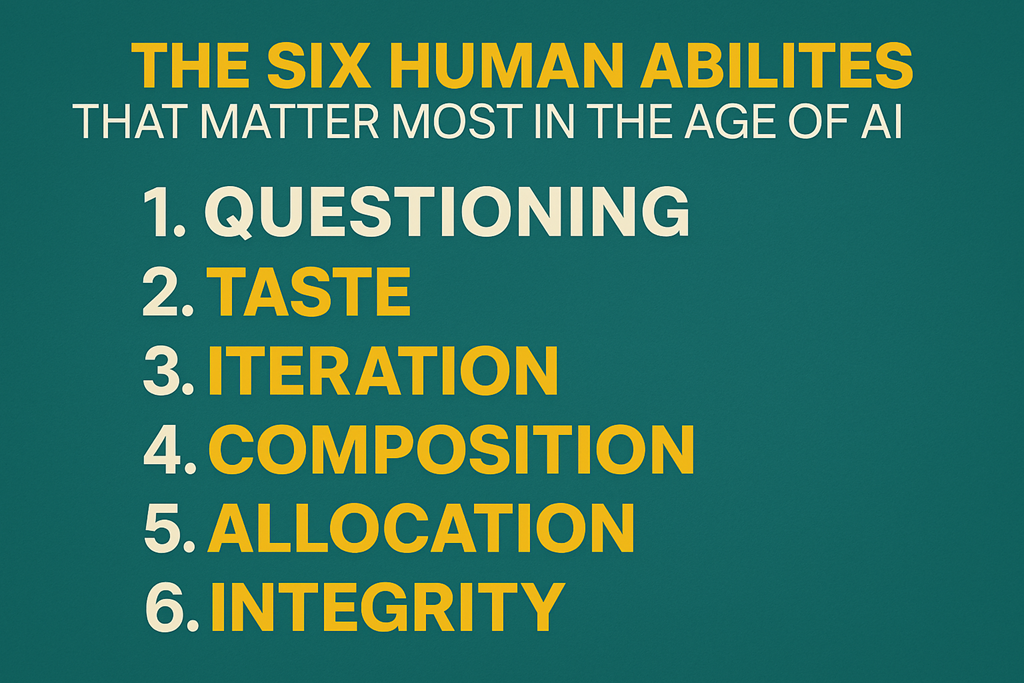
The image above nails it. In an age where machines can generate content, write code, analyse data, and automate workflows at scale, the differentiator isn’t technical capability alone. It’s the human abilities that sit around the technology.
These six skills aren’t soft. They’re not optional. And for MSPs and IT professionals, they may be the difference between being replaced… and being indispensable.
1. Questioning: The Skill AI Can’t Replace
AI is exceptional at answering questions.
It’s terrible at deciding which questions actually matter.
Most poor outcomes with AI don’t come from bad tools. They come from bad prompts, shallow thinking, or unchallenged assumptions. The real value comes from people who know how to ask:
- What problem are we actually solving?
- Who benefits from this answer?
- What’s missing from this output?
In an MSP context, questioning is what separates “we deployed Copilot” from “we changed how the business operates”. It’s knowing when to push back on a client request, when to reframe the problem, and when the obvious solution isn’t the right one.
AI accelerates answers. Humans decide direction.
2. Taste: Knowing What “Good” Looks Like
AI can generate ten versions in seconds.
Taste is knowing which one to ship.
Whether it’s a policy document, a client report, a security recommendation, or a piece of marketing content, AI will happily give you something. What it won’t give you is judgement.
Taste is pattern recognition built over time. It’s experience. It’s knowing when something feels off, even if it technically works. It’s why two MSPs can use the same tools and produce vastly different outcomes.
In a world flooded with AI-generated noise, taste becomes a competitive advantage. Clients don’t pay for volume. They pay for discernment.
3. Iteration: Progress Beats Perfection
AI enables speed, but humans enable momentum.
One of the most overlooked skills in the AI era is the willingness to iterate in public. To test, refine, adjust, and improve without waiting for perfection. AI lowers the cost of iteration dramatically — but only if people are willing to use it that way.
MSPs who succeed with AI don’t roll out massive, once‑off transformations. They make small changes, learn quickly, and build confidence over time. Iteration is how ideas become systems, and experiments become offerings.
AI gives you the draft. Humans do the shaping.
4. Composition: Seeing the Whole, Not Just the Parts
AI is very good at isolated tasks.
Humans are still better at composition.
Composition is the ability to connect ideas, systems, and outcomes into something coherent. It’s understanding how security impacts productivity, how automation affects culture, and how tools interact across the Microsoft ecosystem.
For MSPs, composition is architectural thinking. It’s not just deploying solutions, but designing experiences. It’s knowing how Entra ID, Intune, Defender, Copilot, and business processes fit together — and explaining that clearly to non‑technical decision makers.
AI assists. Humans integrate.
5. Allocation: Deciding Where Effort Belongs
Time and attention are the new scarcity.
AI creates the illusion that everything can be done, all at once. Allocation is the skill of deciding what should be done — and what should be ignored.
Great operators know where human effort adds the most value, and where machines should take over. They know when to automate, when to delegate to AI, and when a human touch is non‑negotiable.
For MSPs under constant pressure, allocation is survival. It’s choosing focus over busyness, leverage over labour, and outcomes over activity.
6. Integrity: The Non‑Negotiable Advantage
This one matters more than most people realise.
As AI becomes capable of generating convincing outputs at scale, trust becomes the real currency. Integrity is what ensures AI is used responsibly, ethically, and transparently — especially when clients don’t fully understand what’s happening behind the scenes.
Integrity shows up in how data is handled, how recommendations are made, and how risks are communicated. It’s choosing long‑term trust over short‑term gains.
Technology changes fast. Reputation doesn’t.
The Bottom Line
AI isn’t replacing humans.
It’s exposing the difference between people who add judgement… and people who just follow instructions.
The future belongs to those who can question, curate, iterate, connect, prioritise, and act with integrity. Tools will come and go. These abilities compound.
And the MSPs who invest in them now won’t just survive the AI era — they’ll define it.
 CIAOPS