
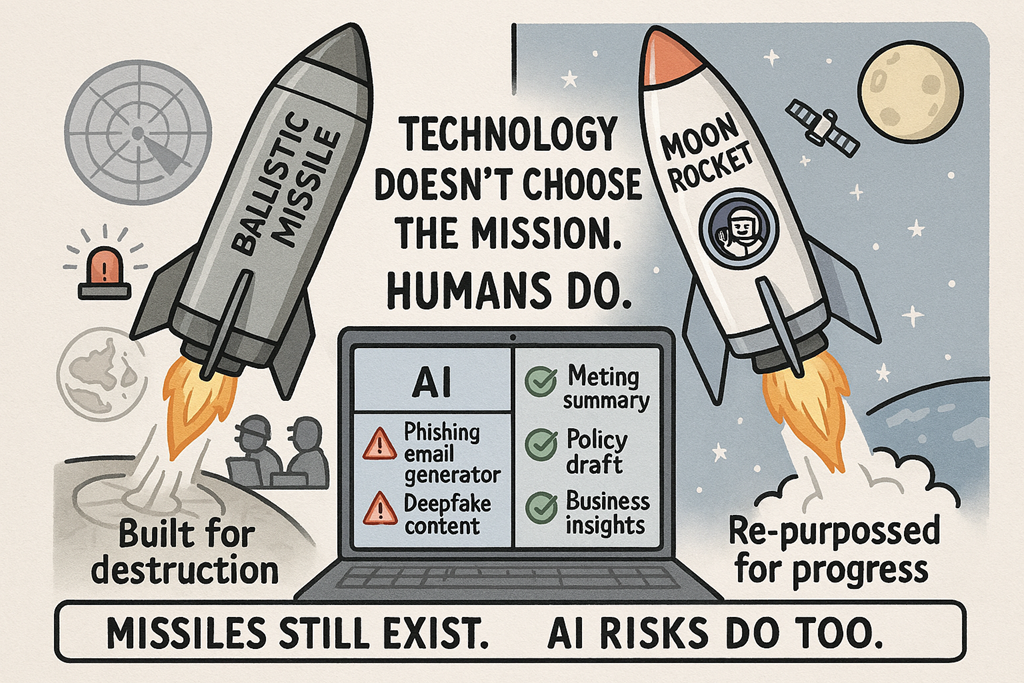
When people get nervous about AI, I often hear the same line: “This is dangerous tech. We should slow it down.”
Fair enough. But history tells us something important here, and it’s worth paying attention to.
One of the most important technologies that put a man on the moon started life as a weapon.
Ballistic missiles were not built for exploration. They were built to deliver destruction over long distances. Cold, deliberate, strategic destruction. Yet the same physics, engineering, and propulsion research behind intercontinental ballistic missiles became the foundation for spaceflight. Without that uncomfortable origin story, the Saturn V never leaves the launch pad, and Neil Armstrong never takes that step.
That doesn’t make missiles good. It makes them dual‑use.
And that’s the lens we should be using when we talk about AI.
Dangerous Origins Don’t Mean Useless Futures
AI didn’t come out of a university lab with a whiteboard and good intentions. Much of the early funding and acceleration came from defence, intelligence, and surveillance use cases. Pattern recognition. Target identification. Signal analysis. Decision support under pressure.
Sound familiar?
Those same capabilities now sit inside Microsoft 365, quietly drafting emails, summarising meetings, analysing spreadsheets, and answering questions that used to burn hours of human effort.
The uncomfortable truth is this: the most powerful tools humans have ever built almost always start life solving hard, often hostile problems. War, competition, scarcity, fear. That’s where money flows fast, constraints are brutal, and innovation accelerates.
AI is no different.
But here’s the mistake people make: they assume that because a technology can be used as a weapon, it will only ever be a weapon.
History says otherwise.
The Moonshot Moment for AI
Once missile technology crossed a certain threshold, its value escaped the battlefield. Suddenly, we weren’t just talking about deterrence. We were talking about satellites, GPS, weather forecasting, global communications, and space exploration.
The same inflection point is happening with AI right now.
We’ve moved from “Can this model do something impressive?” to “How do we embed this capability into everyday work?” That’s the real transition. Not demos. Not hype. Capability.
For businesses, especially SMBs, AI isn’t about replacing humans or unleashing Skynet. It’s about finally getting leverage on the boring, repetitive, soul‑destroying work that drains productivity every single day.
Email triage. Document drafting. Policy writing. Meeting notes. Data analysis. Training. Coaching. Idea generation.
This is the moonshot: not artificial general intelligence, but augmented human intelligence at scale.
But Missiles Are Still Weapons
Now here’s the part too many AI evangelists skip, and it matters.
Missiles didn’t stop being weapons just because they helped us reach the moon.
Even today, the most advanced rockets in the world sit in silos, on submarines, and behind guarded fences. The same technology that launches satellites can still flatten cities.
AI is exactly the same.
Just because we’re using it to improve productivity doesn’t magically make the risks disappear. AI can still be used to manipulate, deceive, automate attacks, leak data, and amplify poor decision‑making at machine speed.
Pretending otherwise is reckless.
This is why governance, guardrails, and education matter more than raw capability. Not bans. Not fear. Not blind adoption. Competence.
The Real Risk Is Not the Tool — It’s the Operator
Most AI failures I see in the real world don’t come from the model. They come from people.
People pasting sensitive data into the wrong tools.
People trusting outputs without understanding limitations.
People automating decisions they don’t actually comprehend.
This isn’t an AI problem. It’s the same problem we’ve always had with powerful tools: we deploy them faster than we train the humans using them.
We didn’t solve missile risk by pretending rockets didn’t exist. We solved it through treaties, controls, oversight, and deep technical understanding.
AI needs the same maturity curve.
Choose Capability Over Panic
So when someone tells me AI is dangerous, my answer is simple: yes, and so was nearly every transformative technology before it.
The question isn’t whether AI can be misused. It absolutely can. The question is whether your organisation will develop the capability to use it well, safely, and deliberately.
Ignoring AI because it scares you doesn’t reduce risk. It increases it. You just outsource the learning curve to attackers, competitors, and less cautious organisations.
Ballistic missiles helped put a man on the moon — and they’re still weapons today. Both truths can exist at the same time.
AI is no different.
The future belongs to the people who understand that tension and choose to master the tool rather than fear it.
 CIAOPS