
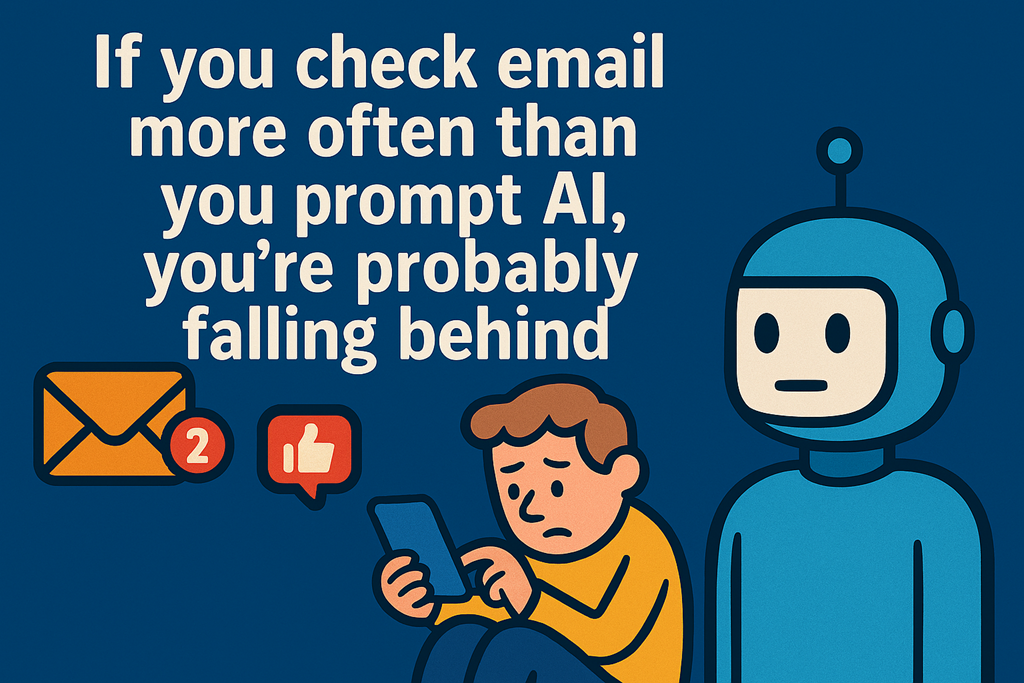
Here’s a simple, uncomfortable question.
How many times today have you checked your email or scrolled social media…
versus how many times you’ve deliberately prompted AI?
If the answer is “a lot more email”, you’re probably not just distracted.
You’re likely falling behind.
Not because email is evil.
Not because LinkedIn is a waste of time.
But because the way work gets done has fundamentally shifted — and many people haven’t adjusted their habits yet.
Attention Is No Longer the Bottleneck
For years, productivity advice focused on managing attention:
- Inbox zero
- Notification control
- Time blocking
- Focus modes
All useful. All still relevant.
But AI changes the equation.
The real bottleneck now isn’t attention — it’s leverage.
AI tools like Microsoft 365 Copilot don’t just save time.
They compress thinking, drafting, analysing, summarising, and planning into minutes instead of hours.
Every time you don’t use them for a task they’re good at, you’re choosing a slower path by default.
And speed compounds.
Email Is Reactive. AI Is Generative.
Checking email is reactive work.
You’re responding to other people’s priorities, context, and framing. Even when it’s important, it’s rarely leverage-heavy.
Prompting AI is generative work.
You’re:
- Creating first drafts instead of staring at blank pages
- Summarising weeks of emails instead of rereading them
- Turning messy thoughts into structured plans
- Extracting actions instead of manually parsing information
One creates momentum.
The other mostly maintains motion.
If you’re opening Outlook out of habit but only opening Copilot when you “have time”, you’ve inverted the value equation.
The New Baseline Is “AI-First” Thinking
High performers aren’t using AI as a novelty anymore. They’re using it as a default interface to work.
Before they:
- Write a document
- Respond to a complex email
- Prepare for a meeting
- Analyse data
- Draft a proposal
They ask AI first.
Not for the final answer — but for acceleration.
This isn’t about replacing thinking.
It’s about removing friction from thinking.
The same way calculators didn’t make accountants dumb, AI won’t make professionals lazy. But refusing to use it will make you slow.
MSPs: This Gap Is Already Showing
In the MSP world, this gap is becoming obvious.
Some teams are:
- Using Copilot to generate SOPs
- Summarising tickets and incidents automatically
- Creating customer-ready reports in minutes
- Turning compliance frameworks into action plans quickly
Others are still:
- Manually writing everything
- Copying and pasting between tools
- “Getting to it later”
- Complaining they’re too busy to learn AI
The irony?
The people “too busy” to prompt AI are usually the ones who need it the most.
Prompting Is a Skill — and It Needs Reps
Here’s the part many miss.
Prompting AI isn’t magic.
It’s a skill.
And like any skill, it improves with repetition.
If you only prompt AI once or twice a day, you’ll never build fluency.
If you prompt it dozens of times, it becomes second nature.
You stop thinking:
“Should I use AI for this?”
And start thinking:
“How should I ask AI to help with this?”
That mental shift is where the real productivity gains live.
A Simple Rule of Thumb
Try this for a week.
Every time you feel the urge to:
- Check email
- Refresh Teams
- Scroll LinkedIn
Ask yourself one question first:
“Is there something I could prompt AI to move forward right now?”
Draft. Summarise. Plan. Refine. Analyse.
You don’t need perfect prompts.
You just need to start.
Because the real risk isn’t AI getting things wrong.
It’s you not using it at all while others quietly build an advantage.
Falling Behind Is Quiet — Until It Isn’t
Nobody sends an alert saying:
“You’re now less productive than your peers.”
It happens gradually.
Others deliver faster.
They think clearer.
They respond sharper.
They scale themselves.
And one day, it’s obvious.
So if you’re checking your inbox twenty times a day but only prompting AI once or twice…
That’s not a productivity strategy.
That’s a warning sign.
 CIAOPS